Can I Counterclaim Against the Plaintiff? A Defendant's Guide to Counterclaims in Malaysia

Being sued does not necessarily mean that you can only defend yourself against the Plaintiff's claim. In some civil disputes, the Defendant may also have a claim against the Plaintiff arising from the same transaction, contract, events or circumstances. Where appropriate, the Defendant may bring that claim against the Plaintiff in the same proceedings by way of a counterclaim.
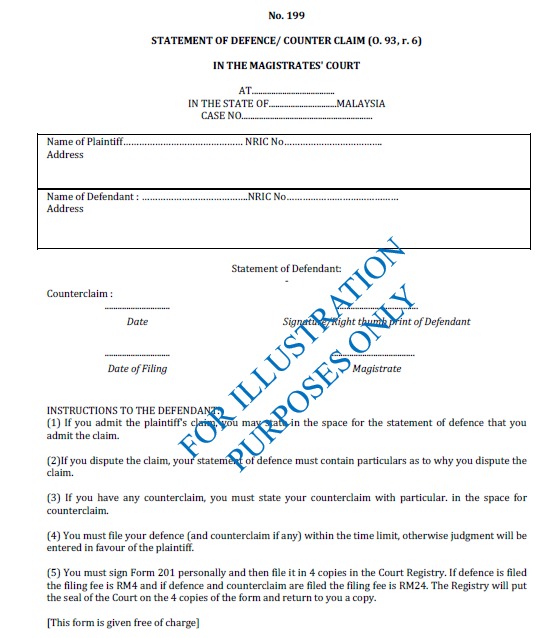
For example, a company may be sued by a supplier for alleged unpaid invoices, while the company says that the supplier breached the contract, supplied defective goods or caused losses. A contractor may be sued by a customer for alleged delay, while the contractor has its own claim for unpaid progress payments.
A counterclaim can therefore be an important part of a Defendant's litigation strategy. However, a counterclaim is not simply a matter of saying that "the Plaintiff is also at fault". It is a separate claim which must be properly pleaded and supported by evidence.
What Is a Counterclaim?
A counterclaim is, broadly, a claim brought by a Defendant against the Plaintiff within the same court proceedings. The Defendant remains the Defendant in relation to the Plaintiff's original claim, but in relation to the counterclaim, the Defendant is effectively advancing its own claim against the Plaintiff. This is different from simply raising a defence. For example:
Defence:
"The Defendant does not owe the RM100,000 claimed by the Plaintiff because the Plaintiff failed to perform its contractual obligations."
Counterclaim:
"The Plaintiff's breach caused the Defendant to suffer RM150,000 in losses, and the Defendant claims damages from the Plaintiff."
The first is an answer to the Plaintiff's claim. The second is the Defendant asserting its own claim for relief. Depending on the facts, a Defendant may therefore have both a Defence and Counterclaim.
When Can only the Defendant Bring a Counterclaim?

Whether a counterclaim is appropriate depends on the facts, the cause of action and the applicable procedural rules. A common situation is where the Defendant's claim arises out of the same transaction or a closely connected set of facts. For example:
- a buyer sues a seller for alleged breach of a sale agreement, while the seller claims damages arising from the buyer's breach;
- a contractor sues for unpaid fees, while the customer counterclaims for defective or incomplete work;
- a supplier sues for unpaid invoices, while the purchaser claims losses caused by defective goods;
- a landlord claims unpaid rent, while the tenant claims damages arising from an alleged breach of the tenancy agreement;
- a company sues a former business partner for breach of contract, while the former partner has its own claim arising from the same contractual relationship.
The important question is not simply whether the Defendant is unhappy with the Plaintiff. The question is whether there is a recognised legal claim against the Plaintiff which can properly be pursued in the proceedings.
A Counterclaim Is Not the Same as a Defence
This distinction is particularly important. Suppose a Plaintiff claims RM200,000 from a company alleging breach of contract.
The company says:
"We did not breach the contract. In fact, the Plaintiff breached the contract first."
That may form part of the company's Defence.But suppose the company also says:
"Because of the Plaintiff's breach, we incurred RM80,000 in additional expenses and lost business."
The company may potentially have a counterclaim for those losses, subject to the applicable law, contractual terms and evidence. A Defendant should therefore consider two separate questions:
First: What can we say to defeat or reduce the Plaintiff's claim?
Second: Does the Defendant itself have a claim against the Plaintiff? These questions should be considered at an early stage rather than after the Defence has already been prepared.
Malaysian Procedural Rules: When Must a Counterclaim Be Raised?
For civil proceedings in the Malaysian courts, the relevant procedural framework generally includes the Rules of Court 2012. A counterclaim is ordinarily pleaded as part of the Defendant's pleadings, commonly in a document described as a Defence and Counterclaim. This is important because a counterclaim is not simply an informal complaint or letter to the Plaintiff. It is part of the formal court pleadings and should identify the material facts and relief being claimed. The Defendant should therefore consider the counterclaim before the Defence is filed, rather than treating it as something that can automatically be added at any later stage.
How Long Do I Have to File a Defence and Counterclaim?
This is one of the most important practical issues for anyone who has just received a Writ of Summons. Under the Rules of Court 2012, the relevant procedural time limits can involve 14-day periods, including the time for entering appearance and, depending on how the Statement of Claim is served and the circumstances of the case, the subsequent filing and service of the Defence. However, the precise deadline should not be calculated merely by reading a general article on the internet. The applicable date can depend on matters including:
- the date and manner of service of the Writ;
- whether the Statement of Claim was served together with the Writ or subsequently;
- whether an appearance has been entered;
- the nature of the proceedings;
- whether an extension of time has been granted;
- whether the court has made any relevant directions or orders; and
- the particular documents served on the Defendant.

For that reason, if you have received a Writ of Summons, do not assume that you have a full 14 days from the day you first read the document. The date of service and the procedural requirements should be checked immediately.
A Simple Example
Suppose a company receives a Writ of Summons and Statement of Claim alleging that it owes RM300,000. The company believes:
- the Plaintiff breached the contract first;
- the company does not owe the RM300,000 claimed; and
- the Plaintiff's breach caused the company to incur RM100,000 in losses.
The company should tell its solicitor about the potential RM100,000 claim at the beginning of the matter. The solicitor can then consider whether the appropriate pleading should include a counterclaim, rather than filing a Defence which addresses only the Plaintiff's claim and attempting to introduce a new claim later.
Plead Material Facts — Not Every Piece of Evidence
This is an important distinction in Malaysian civil litigation. Pleadings are intended to set out the material facts relied upon by the parties. The pleadings are not normally the place to reproduce every WhatsApp message, email, photograph, invoice, evidence or witness statement. For example, instead of putting dozens of pages of WhatsApp conversations into the Defence and Counterclaim, the pleading may set out the material fact that the Plaintiff acknowledged a particular contractual obligation or failed to perform it.
The underlying WhatsApp messages and other documents may then become part of the evidence supporting the pleaded case. This is one reason why a Defendant should provide the solicitor with the complete documentary record, even though every document may not ultimately appear in the pleading.

Can a Counterclaim Be for More Than the Plaintiff's Claim?
Yes, potentially. A counterclaim is not necessarily limited to the amount claimed by the Plaintiff. For example, a Plaintiff may sue a company for RM100,000, while the company may have a properly established counterclaim for RM250,000. The fact that the Defendant's counterclaim is larger than the Plaintiff's claim does not, by itself, prevent the Defendant from asserting the counterclaim.
However, the Defendant must still establish the legal basis and evidence for the amount claimed. An unsupported or exaggerated counterclaim may increase costs and litigation risks rather than improving the Defendant's position. What could be worse than annoying the Judge who is adjudicating and hearing your matter? By being unreasonable and claiming something outrageously impossible.
What If the Defendant Did Not Initially Counterclaim?

This is another reason why early legal advice matters. A Defendant should not assume that there will always be an easy opportunity to add a counterclaim in later stage of the case. Depending on the stage of the proceedings, an amendment to the pleadings may sometimes require the court's permission (leave of court). The other party may also object to a proposed amendment. There may also be limitation issues affecting the Defendant's underlying claim. Accordingly, if a Defendant believes that the Plaintiff has caused it loss, it is better to raise the issue with its solicitor when the Writ of Summons and Statement of Claim are first received.
Should Every Defendant Bring a Counterclaim?
No!

A counterclaim should not be treated as an automatic step whenever someone is sued. There may be cases where the Defendant has a strong Defence but no genuine claim against the Plaintiff. There may also be cases where the Defendant has a potential claim but the commercial value of pursuing it does not justify the additional costs and complexity. Other issues may also matter, including:
- the strength of the evidence;
- the likely value of the claim;
- limitation periods;
- contractual dispute resolution provisions;
- jurisdictional issues;
- availability of documents and witnesses;
- legal costs;
- the possibility of settlement; and
- whether pursuing the counterclaim improves or complicates the overall litigation position.
A counterclaim should therefore form part of the Defendant's overall litigation strategy rather than being used simply to "fight back".
What Documents Should You Give Your Lawyer?
If you are considering a counterclaim, provide your solicitor with the complete background of the transaction, including documents which may initially appear to be unimportant. Depending on the dispute, these may include:
- the contract and subsequent variations;
- quotations and purchase orders;
- invoices and payment records;
- bank statements or payment confirmations;
- emails and WhatsApp communications;
- photographs and videos;
- delivery orders;
- inspection or technical reports;
- correspondence concerning complaints or defects;
- termination letters;
- records of additional expenditure;
- documents showing lost or delayed payments; and
- previous letters of demand or legal correspondence.
Do not selectively provide only the documents which support your position. A solicitor assessing a potential counterclaim needs to understand the full factual chronology, including documents which may potentially be unfavourable to the Defendant.
What Should a Defendant Do Immediately After Receiving a Writ?
If you have received a Writ of Summons and Statement of Claim, do not wait until the deadline is approaching before considering whether you have a counterclaim. A practical first step is to prepare:
1. The court documents
Keep the Writ of Summons, Statement of Claim and all documents served with them.
2. The date of service
Record when and how the documents were served.
3. A chronology
Set out what happened from the beginning of the transaction until the dispute arose.
4. Your own claim
Identify what the Plaintiff did or failed to do which you believe caused you loss.
5. Supporting documents
Gather the contract, invoices, correspondence, WhatsApp messages, bank records and other relevant material. Then provide these documents to your solicitor promptly. The solicitor can assess both sides of the dispute:
How do we defend the Plaintiff's claim?
and
Does the Defendant have a claim of its own?
These two questions can materially affect how the litigation should be approached from the beginning.
Conclusion
Being a Defendant does not necessarily mean that you must remain on the defensive throughout the litigation. In appropriate cases, a Defendant may have its own claim against the Plaintiff and may be able to bring that claim by way of a counterclaim in the same proceedings. Under the Rules of Court 2012, the counterclaim forms part of the formal pleadings and should be properly considered and pleaded.
Procedural deadlines can arise shortly after service of the Writ and Statement of Claim, and the applicable deadline depends on the particular circumstances and documents served. A Defendant should therefore not wait until the Defence deadline is close before telling the solicitor that the Plaintiff also owes money or has caused losses. A counterclaim should be based on a proper cause of action, supported by evidence and considered as part of the overall litigation strategy.
If your company or you personally have received a Writ of Summons and believe that the Plaintiff has also breached a contract, owes you money or has caused you financial loss, do not focus only on defending the Plaintiff's claim. Consider whether you may have a separate claim which should be raised in the proceedings.

Need Advice on a Potential Counterclaim?
If you have received a Writ of Summons and Statement of Claim in Malaysia and believe that you also have a claim against the Plaintiff, our litigation team can review the court documents, relevant agreements and supporting documents and advise on the available options, including whether a counterclaim should be considered. Please contact us as soon as possible after receiving the court papers, particularly where a procedural deadline is running. Early review can be important where the dispute involves substantial sums, contractual obligations, business relationships or a potential counterclaim.